


In the early drafts of America’s origin story, European colonizers and Indigenous peoples are usually cast in rigid, predetermined roles—either as friendly Indians greeting peaceful Pilgrims or, conversely, as foils for Manifest Destiny with white settlers asserting racial superiority over unified Native nations.
The first scene is clearly a myth. But the second story is far more complicated too, according to Professor of History David J. Silverman, an expert in Native American history and the author of six books on Indigenous people and colonial America.
At the start of the colonial era, Europeans didn’t even think of themselves as “white,” Silverman reveals. Nor did the diverse Indigenous groups conceive of themselves collectively as “Indians.”

That, of course, changed. As genocidal struggles unfolded over generations, Euro-Americans embraced a sense of racial identity—and superiority. Faced with warfare and displacement, Native people in turn adopted a pan-Indian identity that transcended tribal boundaries. But “it takes nearly 100 years for those concepts to develop,” Silverman explained. “These identities develop in conversation with one another—as part of the struggle for the continent.”
In his new book, The Chosen and the Damned: Native Americans and the Making of Race in the United States (New York: Bloomsbury, 2026), Silverman follows that conversation across four centuries of racial conflicts, from bloody colonial wars and brutal Indian removal campaigns to the creation of reservations and the rise of Indigenous civil rights movements.
Along the way he notes how systemic racism against Native Americans appears as flashpoints in American history—reflected in the Declaration of Independence itself. And he contends that the story of race in America, typically understood as a Black and white tale, must be rewritten to feature Native voices.
“Native people have been foundational to the racial identities that came into being in the United States,” he says. “But society has an amnesia about Native people’s role, as if Native people have disappeared, as if they’re no longer relevant—if they ever were.”
Correcting the Record
Even inside his own classrooms, Silverman, who has taught Native American and Colonial American history at GW since 2003, is frequently astonished at how ill-informed Americans are about Native people—past and present. In his Native American Racial History course, he routinely answers student questions on how reservations work and whether Native people can vote or pay taxes. Native American history is “practically all new to them,” he said.
During the 2020 racial reckoning following George Floyd’s killing, Silverman was alarmed by the lack of attention to Native people in America’s racial past. “In making the case for the paramount role of race in America, Native people were nowhere to be seen,” he said. “It struck me that this was a deeply distorting approach. And it needed a correction.”
In some ways, The Chosen and the Damned is an effort to set the racial record straight. Silverman starts his story before the founding of the American nation—before the “white” and “Indian” identities took shape. Prior to the 18th century, Europeans defined themselves primarily through religion, not skin color. Elite classes even believed Native people should be converted—“civilized”—into Christian faith and “become absorbed by the superior civilization,” Silverman noted.
But white Americans on the frontier—which initial barely reached passed Boston and later stretched west—viewed Native people as savages incapable of change. “They routinely advocated simply wiping these people off the face of the Earth and taking their land,” Silverman said.
At the same time, Native Americans increasingly adopted Christianity—blurring the religious dividing line between “civilized” European and “savage” Native people. “By the time you get 100 years into colonialism, Christianity just won’t suffice anymore to distinguish Europeans from everyone else,” Silverman said. Instead, Euro-Americans turned to an emerging identity of whiteness which embodied superiority and justified expansion.
Meanwhile Native people forged their own new identity—largely in response to colonial aggression. As early as the 17th century, a series of Indigenous prophets started preaching a common message: The Great Spirit, a concept borrowed from Christianity, created Indians and whites to live separately. “They essentially said, ‘We have a lot more in common with each other than we do with those people,’” Silverman explained. If the white man’s intent was to eliminate Indigenous people, the prophets maintained, “they needed to band together—or be doomed,” Silverman said.
Founding Failures
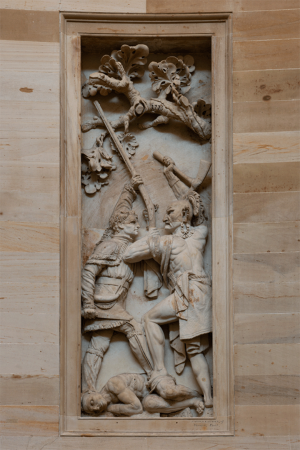
Silverman traces that racial evolution through some of the most significant moments in early American history. The Declaration of Independence itself includes a climactic grievance accusing King George III of unleashing “merciless Indian savages” on the fledgling nation’s frontier. Even under its first president, young America’s military campaigns were focused on conquering Native territory. “George Washington’s administration spent five-sixths of its operating budget fighting Indian wars,” Silverman said.
And the tragic Indian Removal campaign of the 1830s, a brutal episode of forced migration that resulted in over 10,000 Native American deaths, was spurred by a white frontier society determined to eliminate Native people—by law or by violence. “It is a direct result of white supremacist, anti-Indian racism that devalues Native life,” Silverman said.
Still, Silverman says his book is ultimately a story of resilience. The new Indian identity galvanized multi-tribal resistance movements and ultimately led to 20th-century civil rights victories. In the late 19th and early 20th centuries, the U.S. government forced tens of thousands of Native American children to attend “assimilation” boarding schools intended to destroy tribal identities. Instead, they produced new generations of Native leaders who embraced a shared identity and furnished them with a formal education and a common language that led them to band together in national Indian organizations and fight collectively for their rights, Silverman said.
Throughout the 20th century, Native activists and institutions used that unity to advocate for greater autonomy and challenge federal policies. They successfully pushed presidents from Richard Nixon to Barack Obama and Joe Biden to recognize that Native nations should exercise more and more self-government.
“It’s a remarkable achievement,” Silverman said. “You don’t get that without a common Indian identity.”