


By Nick Erickson
Ever since she could remember, George Washington University senior international affairs student Raneem Talal I Akif wanted to be an ambassador.
“That was, like, my first goal as a kid,” she said.
Except growing up in Saudi Arabia, she never saw a woman from her country hold such a role. While gender segregation in Saudi Arabia has transformed in the past couple of years, seeing a lack of representation in policy making only intensified Ms. Akif’s ambitions.
When it was time to consider post-secondary education, she realized she might have limited options at home. Ms. Akif extended the boundaries of her search beyond Saudi Arabia, especially after noting that women entering ministry positions now in her home country could only gain the necessary education and experience for those roles elsewhere.
“There was no major that was either political science or international affairs for women,” said Ms. Akif, who was raised in Saudi Arabia’s capital city of Riyadh. “And that made me want it more.”
Following in the footsteps of her two older sisters, Ms. Akif decided to study abroad. She moved from Saudi Arabia to the United States in August 2018, starting at George Mason University before enrolling at GW in spring 2019, mostly because of the renowned Elliott School of International Affairs.
Ms. Akif is scheduled to finish up her undergraduate degree this May, and she’ll do so representing the benefits of international education, which is celebrated formally Monday through Friday in an annual week set aside to recognize students such as Ms. Akif.
GW offers a breadth of international education opportunities. The university hosts more than 4,000 students, faculty and staff from 130 countries, while more than 1,000 students study abroad every academic year while participating in more than 150 programs. Just recently, GW was named the top medium enrollment producer of the Benjamin A. Gilman Scholarship, which mobilizes undergraduate Federal Pell Grant recipients to study abroad.
That commitment to global education is a big reason Ama Appiah, who will be wrapping up her M.B.A. this spring, chose GW for graduate school. Ms. Appiah had taken an interest in Korean dance after her undergraduate studies at the University of Connecticut, where she was the student government president, and began learning about the culture during her spare time.
She taught herself the language and wanted to immerse herself in that culture, which was a factor when it came time to select a place to pursue her M.B.A. GW fit the bill, and she will spend next spring at Korea University in Seoul while also working for Korea’s HP headquarters. Ms. Appiah is grateful GW has given her such an opportunity.
“That’s what excited me about coming to GW,” said Ms. Appiah, a Forte Fellow who hopes to work in some type of creative communications or marketing in sectors such as entertainment or technology. “Everything is really taught through that global, diversity and inclusion lens, and no matter what discipline you’re in, you know you have to know those angles just to be a better citizen. That’s what makes GW different from other schools.”
Those immersion and cultural experiences can have a lasting impact. Christine Brown-Quinn, M.B.A. ‘92, is president of GW Alumni. Based out of London working as career strategist, author and consultant, she is one of the more than 10,000 alumni—including both expatriates and international students who returned to their country of origin after graduation—living and working abroad. She said that number, as well as the tens of thousands of alumni working in international organizations across a multitude of specialties, is a testament to the university’s global reach and outlook.
"One of the distinguishing factors of the George Washington University is its ability to offer students a top-notch international education in Washington, D.C., a global capital as well as an extensive range of study abroad experiences,” Ms. Brown-Quinn said. “The issues of today are complex, and that international outlook empowers our community to be at the forefront of solving some of the world's biggest challenges."
While the benefits are plentiful, sometimes first steps can be the hardest. International students and students studying abroad are encouraged to take advantage of available resources. The Office of Study Abroad, for instance, has events this week such as “Being Black Abroad” and “How to be a U.S. Representative Abroad.” There is also the Multicultural Student Services Center. While it can be overwhelming to embark on new territory, Ms. Akif and Ms. Appiah both advise students to not be afraid to step outside of comfort zones and embrace the settings around them.
“I would say exposing yourself to other cultures is really important. You can have a wider perspective and understanding of life, and I think it’s really important not to limit yourself,” said Ms. Akif, who knows a thing or two about challenging limits. “There are a lot of things I've gotten to do over the past year or two that I would never have imagined being capable of just because I was put in certain positions.”
Short-Term Abroad Programs present a fantastic way to enhance the academic experience for both students and faculty. While traveling abroad together, groups can find new layers of knowledge and culture that they can then bring back and share with the GW community.
Some topics may seem like a natural fit for a study abroad course, such as studying Shakespeare in London or examining the history of WWII in Germany. Past GW Short-Term Abroad Programs have included Art Therapy in India, Music in Brazil, Education Policy in Turkey, Urban Sustainability in Panama, Health Management in Israel, and many more programs around the world.
Whether you are a faculty member hoping to create an STAP course, or a student eager to apply for one, CCAS global is here to support you. Please direct any questions and concerns to ccasglobal gwu [dot] edu (ccasglobal[at]gwu[dot]edu).
CCAS Spring 2022 STAP
International Media Seminar in Paris (SMPA3195)
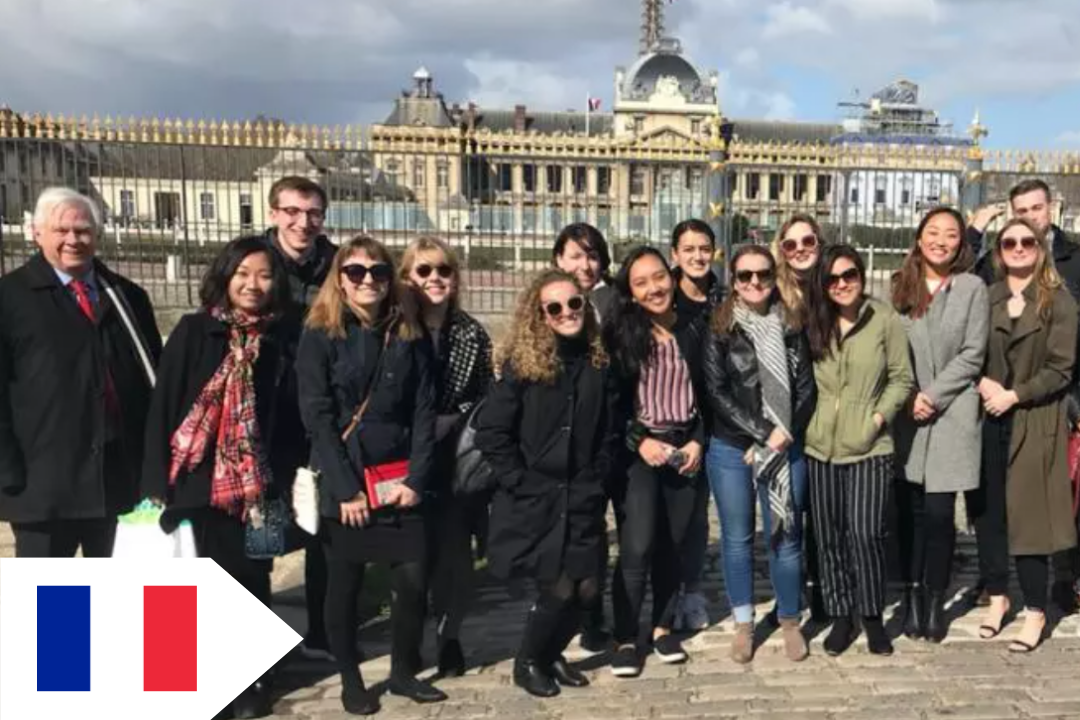
The short-term International Media Seminar program combines the excitement of spending spring break in Paris with a unique learning experience, focused on the changing nature of communications media in a new global environment.
During the course of the spring break, students will meet with some two dozen international media leaders — journalists, executives, scholars, and government officials. Meetings are held in classrooms, media offices, production facilities and private homes — offering a once in a lifetime behind-the-scenes experience. Free time is also scheduled into the program so that students have the chance to see the sites and enjoy the city.
Over the past fourteen years, students at the George Washington University have been able to participate in the Paris Seminar as part of a regular three-credit course SMPA 3195, "Globalization and the Media", open to all GW undergraduate and graduate students. The program is taught and chaired by Professor Lee Huebner. Student participants have found the Paris Media seminar to be a highlight of their university careers — introducing them to new places, new perspectives and new personalities. As one recent participant put it, "the Paris trip was life-changing… the trip of a lifetime."
You can view a detailed description of the course and trip (PDF). Questions about the trip and the course can be addressed to Professor Lee Huebner at huebnergwu [dot] edu (huebner[at]gwu[dot]edu).
Both the course and the Paris Seminar are designed to give undergraduate and graduate students an opportunity to study the global media landscape from a truly international perspective — not only in theory, but in fact. By talking with a wide array of experts who live and work in a foreign media environment, students are able to see familiar media issues in a new light — even as they become more familiar with other media cultures.
The Price of Freedom: Normandy 1944 (History 3044W)
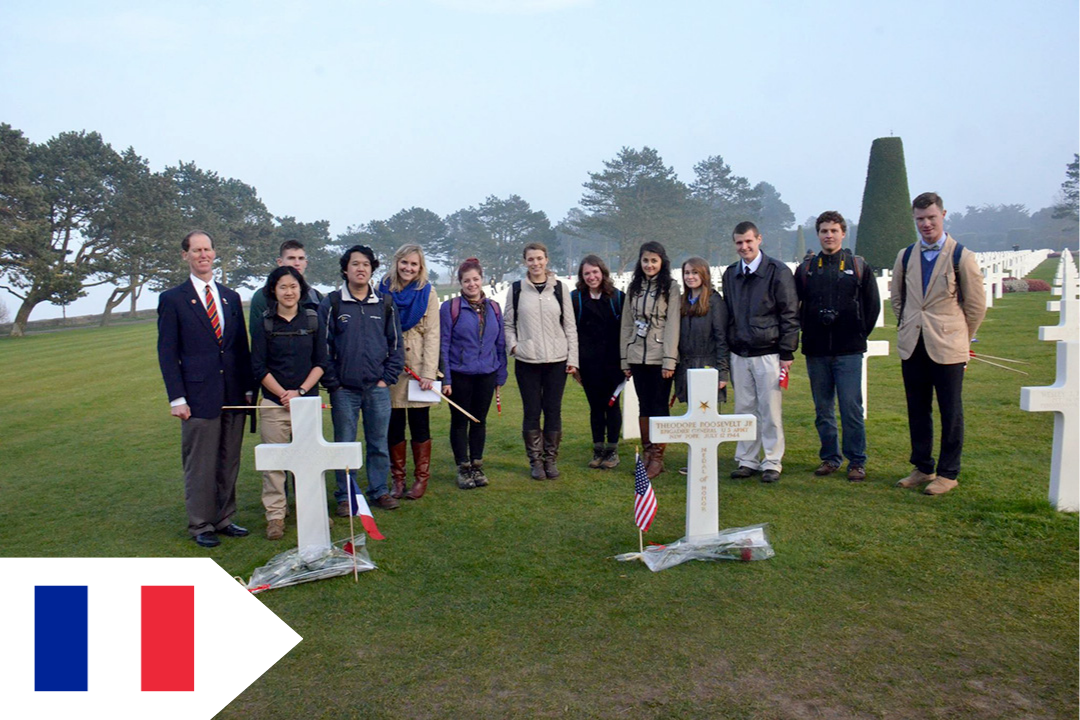
“The Price of Freedom: Normandy 1944” (History 3044W) is an experiential course which explores the causes, conduct, and consequences of modern war through the vehicle of the 1944 Normandy Campaign, examining its impact on individuals, communities, and the nation.
Through an extensive series of lectures, discussions, and films we explore the massive, complex, and uncertain D-Day invasion and the fighting through the liberation of Paris. The course will carry 4 credits, satisfy a WiD requirement, and meet GPAC elements for Global Perspective, Oral Communication, and Critical Thinking. The course will be limited to 17 students. It will meet for lectures on Tuesday and Thursday from 4:45 to 6:00 pm, discussion on Thursday from 6:00 to 7:00 pm, and on Thursday, after discussion, for watching films from 7:00 until 9:30 pm or so. Each student writes four papers, including a biography of a soldier from his or her hometown who died in the Normandy Campaign and who is buried in the Normandy American Cemetery.
Then, Pandemic permitting, on Friday night, March 11, 2022, the class will fly to London to begin a rigorous “staff ride” (that’s army-speak for a participatory, educational tour) of the entire campaign – all the way from the planning in England to the beaches and on to Paris. Each student will conduct a briefing about some element of the campaign at the appropriate location. The highlight of the trip will be a visit to the actual landing beaches and the laying of a wreath at the memorial in the American Cemetery at Omaha Beach, followed by each student presenting a eulogy for his or her soldier at the soldier’s graveside. We’ll return Tuesday, 23 March.
To apply for the course, please submit a written application to Professor Long by 5pm on Friday, October 15, 2021. You can obtain the Application in the History Department Office (Phillips 335), or from Professor Long (Phillips 300). Professor Long will interview each applicant and the successful applicants will submit an application, through GW Passport, to the CCAS Office of Global Initiatives.
It is anticipated that the additional expense associated with the travel element of the course will be about $4,700 for items like airfare, hotels, some meals, bus transport, etc. In addition, you should plan on taking about $350 - $400 to cover the cost of 4 lunches, 5 dinners (plus any spending money). You will be required to make a $500 deposit when you are accepted for the course. One half of the balance will be due on January 10, 2022, and the balance on February 10. A limited amount of scholarship money is likely to be available for students who require assistance to be able to participate. Please try to evaluate your circumstances carefully.
Disability and the Holocaust in Germany (ENGL3912)

In the 1980s, nearly four decades after the formal end of World War II, a group of German and American historians began connecting the genocide of 6 million Jewish (as well as Romany, Russian, and gay) people in the Holocaust to the mass killings of 300,000 disabled people in psychiatric hospitals, clinics, and institutions. The “euthanasia murders” began in October 1939 nearly a year and a half before the advent of the “final solution” in Nazi death camps. The research caused a great deal of debate amongst Holocaust scholars due to the fact that medical killings were treated separately from those prosecuted for Nazi war crimes during the Nuremburg trials. Many believe that physician supervised killings in medical institutions counted as treatment for those classified as “lives unworthy of life” (i.e. those diagnosed with physical, cognitive, and sensory disorders and, in the terms of the time, incapable of productive labor). In 2014, following decades of disability activism, the first state supported memorial to those killed in the T4 program opened in Berlin.
The class will grapple with questions of the relationship of medical murders to Holocaust genocide, the struggle to publically memorialize the T4 killings in Germany, as well as consider how this history affects the lives of German disabled people today. The highlight of our reflections will be a visit to Berlin during spring break to experience the historical sites about which we have been reading: the Topography of Terror, the Jewish Museum, Otto Weidt’s Blindenwerkstatte, The Wannsee Konferenz Haus, the Brandenburg Gedenkstatte, the Psychiatriemuseum, Sachsenhausen concentration camp, and Bernburg Psychiatric Hospital. We will also be exposed to the thoughts of German students studying the T4 program, the poetry of American expatriate Kenny Fries, Disability Studies scholar Petra Fuchs, German Holocaust historian Robert Parzer, and disability tour guide (TBA). Our work will culminate with a collective creative project presented to the Dean’s Scholars in Globalization Council in mid-April.