

As the U.S. Open Tennis Championships served up excitement in New York the last few weeks, audiences marveled at overhead smashes, gravity-bending groundstrokes and slices and bounces that seemed to defy the laws of physics.
Or did they? In fact, behind every game, set and match on the Arthur Ashe Stadium hardcourt was a physics experiment in motion.
Like most sports, tennis is, in many ways, a fast-paced science lab, a masterclass in momentum, friction and a ball-spinning force called the Magnus Effect. You don’t need a PhD in physics—or even a killer forehand—to appreciate how these factors shape the game. But Physics Department Chair Alexander van der Horst, who, as a veteran tennis tournament player himself, has both, explained that there’s a classroom lesson in every point.

“Surfaces, the rotation of the ball, what the player can do on the court—physics principles govern how the game is played,” he said.
A little physics education can go a long way toward improving your own on-court skills. While coaching kids and adults at the Lafayette Tennis Association in Chevy Chase, former physics major Amy Georgescu, BS ’25, said she leans into language from her CCAS studies to help students ace their game.
“When I’m teaching a younger kid, I’ll explain about momentum and how it helps them generate power and move the ball forward,” she said. “They’ll say, ‘Physics? Isn’t that math?’ But I tell them it’s also tennis!”
Friendly Friction
With different tennis surfaces applying different physics principles—from the grass of Wimbledon to the clay of the French Open to the U.S. Open hardcourt—van der Horst pointed to friction as one of the biggest scientific factors influencing the sport. “It impacts the pace of the game, the spin of the ball and the height of the bounce,” he said.
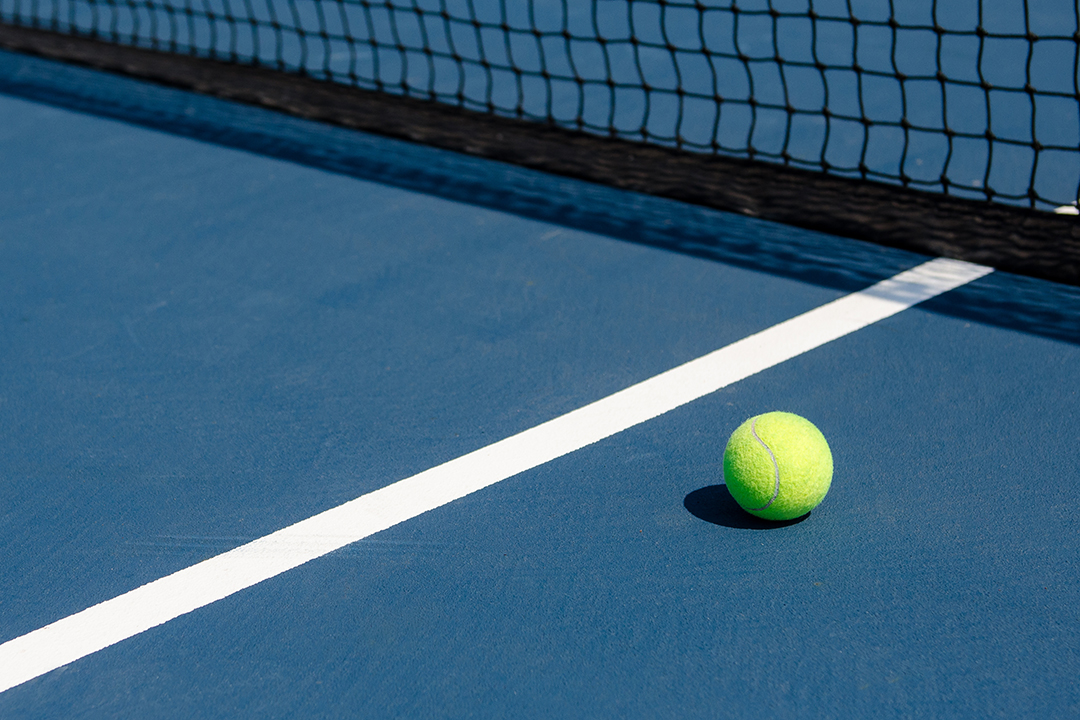
Clay has the most friction and grass the least. Hardcourts, such as the U.S. Open surfaces, generally fall in-between.
Clay’s friction slows the ball when it hits the surface. It also gives the ball more spin; the surface tries to slow the bottom spin of the rotating ball, but the top gets an extra spin—or top spin. At the same time, the friction causes more vertical movement than horizontal. The ball actually bounces higher.
“On the friction-heavy clay, you get slower ball speed, more spin and higher bounces,” van der Horst explained.
Grass is the other extreme. It has very low friction, so the pace is faster. There’s less spin; the ball almost rotates backward. And there’s a lower bounce.
“The hardcourt at the U.S. Open this week is kind of in the middle—a medium friction for a medium pace, spin and bounce,” van der Horst noted.
Clay and grass courts call for very different types of play. Van der Horst’s own game, honed on the Netherlands clay surfaces of his youth, compares—imperfectly, he joked—with clay specialist Rafael Nadal, who dominated at the French Open’s Roland-Garros. Still, van der Horst idolized the impeccable timing and touch of grass court wizards like Stefan Edberg, Pete Sampras and Roger Federer, whose serve-and-volley skills captured multiple Wimbledon titles.
“I appreciate those players for whom the game is elegant and appears easy,” he said, adding with a laugh, “I have always had to do the hard work. My game never looks easy.”
Spin Doctors
Spin—topspin, backspin, sidespin—is the unsung force that makes the tennis world go around.
Essentially, players manipulate air pressure and motion to control the arc of the ball—a scientific principle called the Magnus Effect, which explains how a spinning object moving through fluid (like air or water) curves away from its initial path.
For tennis, topspin means the top of the ball spins forward, pushing air downward and causing the ball to drop rapidly. The downward Magnus force also allows the player to hit the ball harder and more aggressively. At the same time, the high bounce that results from a topspin ball striking the ground at a steep trajectory can force opponents to adjust their strokes.
Backspin—also called slice—does the opposite. A shot hit with backspin will have a flat trajectory, due to the upward Magnus force resisting the downward pull of gravity. The ball floats, stays low and can die on a bounce—perfect for drop shots that sink at the net. There’s even a sidespin effect, where the ball rotates around a vertical axis and curves sideways in mid-air.
Momentum Mastery
Georgescu’s lessons often swing on momentum—an object’s mass multiplied by its velocity.
In tennis talk, the momentum generated by the mass and velocity of players and their rackets is transferred to the ball. Georgescu doesn’t spell out the equation to her students. Instead, she encourages them to focus on forward movement—from their swing to their follow-through. “They’ve generated the momentum of their rackets, their shoulders, their hips all moving to get to the ball—that’s where their power comes from,” she said.
On and off the court, professional tennis teams—like many other sports—routinely take full advantage of sports science, van der Horst noted. Evolving equipment technology, for example, maximizes the size of a racket’s momentum-optimal “sweet spot.”
Other sports have followed suit. Cyclists, for example, use wind tunnels for aerodynamic training while baseball players adjust their swings to a ball’s launch angle. Indeed, most teams assemble training staffs with degrees in everything from nutrition to sport physiology—a career path that appealed to van der Horst’s love of the game. “I always thought if I hadn’t chosen astrophysics, I’d have gone into the physics of sports,” he mused.
And while Georgescu said her physics degree has sharpened her game, she thinks more about footwork than formulas during matches. “The physics knowledge definitely comes in handy,” she said. “But it feels great just to ace someone on the hardcourt.”